Products and configurations to compare
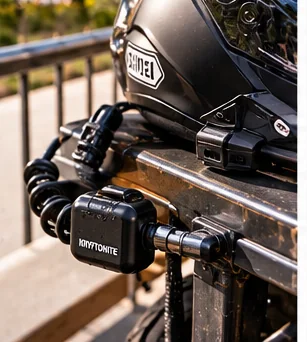
Coiled motorcycle helmet cable lock
Easy to carry.
Best when: you lock one or two helmets briefly
Watch for: cables are deterrents, not high-security chains
D-ring helmet lock carabiner
Tiny pocket tool.
Best when: your helmet uses accessible D-rings
Watch for: not useful for every ratchet or strap design
Handlebar helmet lock bracket
Always available on the bike.
Best when: you want no loose cable in luggage
Watch for: fit depends on bar/frame and can leave helmet exposed
Secure through a structural opening
Do not rely on removable trim pieces.
Keep the helmet off hot exhaust
Locked helmets can swing into pipes or wheels.
Weather still matters
Rain can soak liners and electronics.
Cable location should not damage paint
Avoid grinding metal hardware against the bike.
Bring premium helmets inside overnight
Locks are for short stops, not secure storage.
Helmet storage should protect both the shell and the EPS
Store a helmet where it cannot fall, be crushed or absorb fumes from fuel and solvents. A padded helmet bag protects the finish during transport, while a hard case or dedicated shelf provides more impact protection at home. Do not hang heavy helmets for long periods by thin interior edges or straps in a way that deforms comfort padding.
Locks are theft deterrents, not protective storage. Running a cable through the chin bar or D-rings can secure a helmet briefly at a stop, but weather, tampering and accidental knocks remain possible. Expensive helmets are safer brought inside when practical.
Air the helmet before bagging it
Putting a sweaty or rain-soaked helmet straight into a closed bag traps moisture and odor. Dry the liner first, then use the bag for dust and scuff protection.
Before checkout
- Accessory is explicitly compatible with the exact helmet model
- Nothing compromises shell, EPS, retention strap or emergency-release hardware
- Visor or Pinlock part number matches the exact shield
- Speaker/mic placement creates no pressure points
- Camera mount does not block vents or visor travel
- Tint remains legal and usable for expected light conditions
- Cleaning product is safe for visor coatings and shell material
- Storage allows helmet to dry before sealing it in a bag
- Replacement pads/liners are OEM or verified compatible
- Accessory improves a repeated riding problem rather than adding clutter
The accessory must not weaken the helmet
A motorcycle helmet is protective equipment first. Every speaker, mount, adhesive, camera, replacement pad and visor should work around the certified structure rather than forcing the structure to adapt to the accessory. Avoid drilling the shell, cutting EPS, blocking emergency tabs or routing hard objects where they can create pressure points against the head.
Compatibility names can also be misleading. “58 mm” style near-standards from other industries do not really exist here: visor geometry, cheek-pad snaps, speaker pockets and shell generations are usually model-specific. Exact part number beats visual similarity.
First-ride test
Test new helmet gear on a short familiar ride. Confirm the visor seals and locks, speakers do not press the ears, the communicator can be operated without looking down, the camera creates no distracting drag, and earplugs remain comfortable after thirty minutes. Stop and fix pressure or visibility issues rather than assuming you will “get used to it.”
After the ride, inspect mounts and cables, dry anything damp, and check that nothing shifted inside the liner. Good helmet accessories should become almost invisible once the ride starts.
Frequently asked questions
Are helmet locks theft-proof?
No.
Can I lock through the chin bar?
On compatible full-face helmets without damaging trim.
What about modular helmets?
Make sure the locking point cannot open or detach.
Should I leave a Cardo on the helmet?
Remove expensive modules when theft risk is meaningful.
Affiliate disclosure: MotorcycleHelmets.co may earn from qualifying purchases through Amazon Associates and eBay Partner Network at no extra cost to you. Amazon links use scouttheory-20; eBay links use campaign 5339137014.