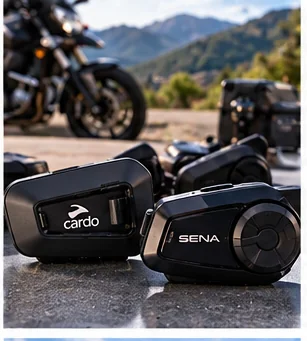
Products and configurations to compare
Cardo Packtalk Edge
Strong voice control and waterproof construction.
Best when: you ride solo now but may join Cardo groups
Watch for: you pay for mesh features you may not use
Sena 50S
Long battery life and voice/phone integration.
Best when: you expect Sena group riding later
Watch for: premium cost for solo use
Midrange Bluetooth helmet headset
Skip mesh pricing if group comms are unlikely.
Best when: music/nav/calls are the main goal
Watch for: speaker and mic quality vary
Solo riding changes the feature hierarchy
Group size and mesh reconnect behavior become secondary.
Voice controls can reduce button use
Hands should stay on controls; learn commands before riding.
Navigation prompts need intelligibility, not huge bass
Clear mids and correct speaker placement matter.
Battery should outlast your longest normal ride
Fast charging is useful during lunch stops.
Waterproofing matters even for commuters
Weather changes faster than ride plans.
Helmet intercoms are ecosystem purchases
The biggest decision is not speaker wattage. It is who you ride with and which network they already use. Cardo's DMC mesh and Sena's Mesh Intercom are separate ecosystems for native mesh group riding, even though both brands support cross-brand Bluetooth-style connections in some form. If your regular group already owns one ecosystem, compatibility can matter more than a small difference in battery life or speaker branding.
For solo riders, the priorities shift toward phone calls, navigation prompts, music, voice control and battery life. A premium mesh unit may be unnecessary if you rarely ride with others. Conversely, touring groups benefit from mesh that can reconnect automatically as riders spread out and rejoin.
Speaker fit changes perceived audio more than specs
Helmet speaker pockets vary in depth and position. A speaker sitting 10 mm away from the ear sounds dramatically worse than one aligned correctly. Use the included spacer pads where appropriate, keep speakers from pressing painfully into the ear and route cables so they do not cross impact-management foam or create pressure points.
Before checkout
- Accessory is explicitly compatible with the exact helmet model
- Nothing compromises shell, EPS, retention strap or emergency-release hardware
- Visor or Pinlock part number matches the exact shield
- Speaker/mic placement creates no pressure points
- Camera mount does not block vents or visor travel
- Tint remains legal and usable for expected light conditions
- Cleaning product is safe for visor coatings and shell material
- Storage allows helmet to dry before sealing it in a bag
- Replacement pads/liners are OEM or verified compatible
- Accessory improves a repeated riding problem rather than adding clutter
The accessory must not weaken the helmet
A motorcycle helmet is protective equipment first. Every speaker, mount, adhesive, camera, replacement pad and visor should work around the certified structure rather than forcing the structure to adapt to the accessory. Avoid drilling the shell, cutting EPS, blocking emergency tabs or routing hard objects where they can create pressure points against the head.
Compatibility names can also be misleading. “58 mm” style near-standards from other industries do not really exist here: visor geometry, cheek-pad snaps, speaker pockets and shell generations are usually model-specific. Exact part number beats visual similarity.
First-ride test
Test new helmet gear on a short familiar ride. Confirm the visor seals and locks, speakers do not press the ears, the communicator can be operated without looking down, the camera creates no distracting drag, and earplugs remain comfortable after thirty minutes. Stop and fix pressure or visibility issues rather than assuming you will “get used to it.”
After the ride, inspect mounts and cables, dry anything damp, and check that nothing shifted inside the liner. Good helmet accessories should become almost invisible once the ride starts.
Frequently asked questions
Do solo riders need mesh?
No, not unless future group riding justifies it.
Can I hear navigation with earplugs?
Often better, because earplugs reduce wind noise; speaker fit and volume still matter.
Can I take calls safely?
Use voice/hands-free features and only when local law and riding conditions permit.
Is premium audio worth it?
Only if the speakers fit the helmet and you value music quality.
Current product/source checks
Affiliate disclosure: MotorcycleHelmets.co may earn from qualifying purchases through Amazon Associates and eBay Partner Network at no extra cost to you. Amazon links use scouttheory-20; eBay links use campaign 5339137014.