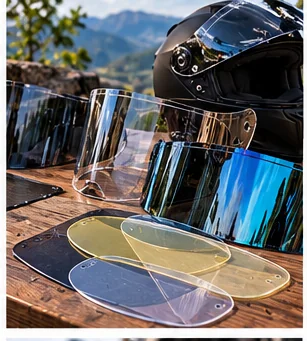
Products and configurations to compare
Photochromic visor / insert
Avoid roadside visor swaps.
Best when: rides transition between clouds and sun
Watch for: tint range and UV response vary
OEM clear visor
Maximum predictable transmission.
Best when: you ride after dark
Watch for: requires carrying/installation if paired with dark visor
OEM dark smoke visor
Strong fixed glare reduction.
Best when: bright daytime rides dominate
Watch for: not suitable for all night/legal conditions
UV-blocking windscreens can affect photochromic response
The lens may not darken as much behind certain screens.
Dedicated dark remains predictable
It does not wait for chemistry to react.
Travel adds storage problem
A spare shield needs a soft sleeve and protected luggage location.
Pinlock compatibility is separate
Some shields support anti-fog inserts; confirm exact part numbers.
Carry cleaning supplies
Photochromic coatings deserve gentle care.
Visor accessories must be exact-fit parts
Pinlock inserts, replacement shields and photochromic options are visor-specific. A lens labeled for one helmet family may look almost identical to another and still fail to seal or align with the pins. Shop by exact helmet model, shell generation and visor code rather than by visor width alone.
Anti-fog inserts work because an inner moisture-absorbing lens and sealed air gap create a thermal barrier. That means installation tension and sealing matter. A Pinlock insert that is too loose can fog at the edges; overtensioning can distort the insert or visor.
Tint is a visibility tool, not decoration
Dark smoke shields can be excellent in bright sun but poor after dusk or in rain. Photochromic inserts and shields trade maximum darkness for convenience. If a ride may extend after sunset, carry a legal clear solution appropriate to the helmet and jurisdiction.
Before checkout
- Accessory is explicitly compatible with the exact helmet model
- Nothing compromises shell, EPS, retention strap or emergency-release hardware
- Visor or Pinlock part number matches the exact shield
- Speaker/mic placement creates no pressure points
- Camera mount does not block vents or visor travel
- Tint remains legal and usable for expected light conditions
- Cleaning product is safe for visor coatings and shell material
- Storage allows helmet to dry before sealing it in a bag
- Replacement pads/liners are OEM or verified compatible
- Accessory improves a repeated riding problem rather than adding clutter
The accessory must not weaken the helmet
A motorcycle helmet is protective equipment first. Every speaker, mount, adhesive, camera, replacement pad and visor should work around the certified structure rather than forcing the structure to adapt to the accessory. Avoid drilling the shell, cutting EPS, blocking emergency tabs or routing hard objects where they can create pressure points against the head.
Compatibility names can also be misleading. “58 mm” style near-standards from other industries do not really exist here: visor geometry, cheek-pad snaps, speaker pockets and shell generations are usually model-specific. Exact part number beats visual similarity.
First-ride test
Test new helmet gear on a short familiar ride. Confirm the visor seals and locks, speakers do not press the ears, the communicator can be operated without looking down, the camera creates no distracting drag, and earplugs remain comfortable after thirty minutes. Stop and fix pressure or visibility issues rather than assuming you will “get used to it.”
After the ride, inspect mounts and cables, dry anything damp, and check that nothing shifted inside the liner. Good helmet accessories should become almost invisible once the ride starts.
Frequently asked questions
Does photochromic get as dark as smoke?
Not always.
Can it work at night?
Many photochromic products return toward clear, but check visible-light transmission and local law.
Do I need a spare shield?
Touring riders may still carry clear backup.
Can I add Pinlock to photochromic?
Depends on whether the photochromic component is the shield or an insert and the exact helmet system.
Current product/source checks
Affiliate disclosure: MotorcycleHelmets.co may earn from qualifying purchases through Amazon Associates and eBay Partner Network at no extra cost to you. Amazon links use scouttheory-20; eBay links use campaign 5339137014.